
Retaining Walls in Mill Spring, NC.
Mill Spring is the lowest town we serve, at 931 feet, and it is far from flat: the soil survey maps 71% of the ground here at a 15% slope or steeper.
We'll reach out within 24 hours to schedule your free on-site estimate. Prefer to talk now? Call (828) 702-7125.
- We confirm the details and book a time
- We walk the site and talk through the slope, soil, and access
- You get a clear, written, line-item scope
Usually a long one built for acreage. Within a mile and a half of Mill Spring the USDA soil survey maps 71% of the ground at a 15% slope or steeper and 40% at 30% or steeper, and the median lot is 4.26 acres. The largest soil unit is Pacolet sandy clay loam on 15 to 25 percent slopes, 26% of the area. On that grade, 20 feet of level ground takes about 4 feet of wall. On acreage like this a wall holds a drive cut, a barn or arena pad, or a house site carved into a hillside.
Pacolet clay, Rion sand and rock outcrop
The ground around Mill Spring drains to the Green River, with Little White Oak Creek and Britten Creek on the way. Three soils make up most of it. Pacolet sandy clay loam covers 26% of the area on 15 to 25 percent slopes and another 12% on 8 to 15 percent. Rion sandy loam on 25 to 45 percent slopes covers 21%. And a Rion, Ashlar and Rock outcrop complex on 45 to 70 percent slopes covers 16%, which is ground with rock at the surface. Away from that complex the soil is fairly deep: across the circle, bedrock is within 40 inches under 17% of the ground.
Boulder retaining walls and block walls on acreage
With 89.9% of lots at an acre or more, access is rarely tight, and that favors big stone. A boulder retaining wall along a drive or below a pad goes up quickly with an excavator, and its weight does the holding. Where a wall supports a building pad or has to stand tall, segmental block with geogrid gives a predictable, engineered result. On the Rion ground a 35 percent grade turns 20 feet of level pad into 7 feet of wall, so pads are often cut and filled to split the difference. Stone or boulder runs $35 to $90 per square foot of wall face in Western NC and block $30 to $60.
Retaining wall repair in Mill Spring
The clay here is labeled moderately eroded in the survey, so rain runs across it. The nearest NOAA station is 5.7 miles away and averages 60 inches of precipitation a year. On a long wall the weak points are the low spots, where runoff gathers and either pours over the top or soaks the backfill. We find those spots, rebuild the damaged stretch with drainage stone and an outlet, and shape the ground above so water spreads out. Typical residential wall projects in Western NC run $4,000 to $25,000.
See the full service on our retaining walls page, and the wider Mill Spring service area.
USDA soil survey, USGS and NOAA figures for the ground within 1.5 miles of Mill Spring.
Photos from recent jobs
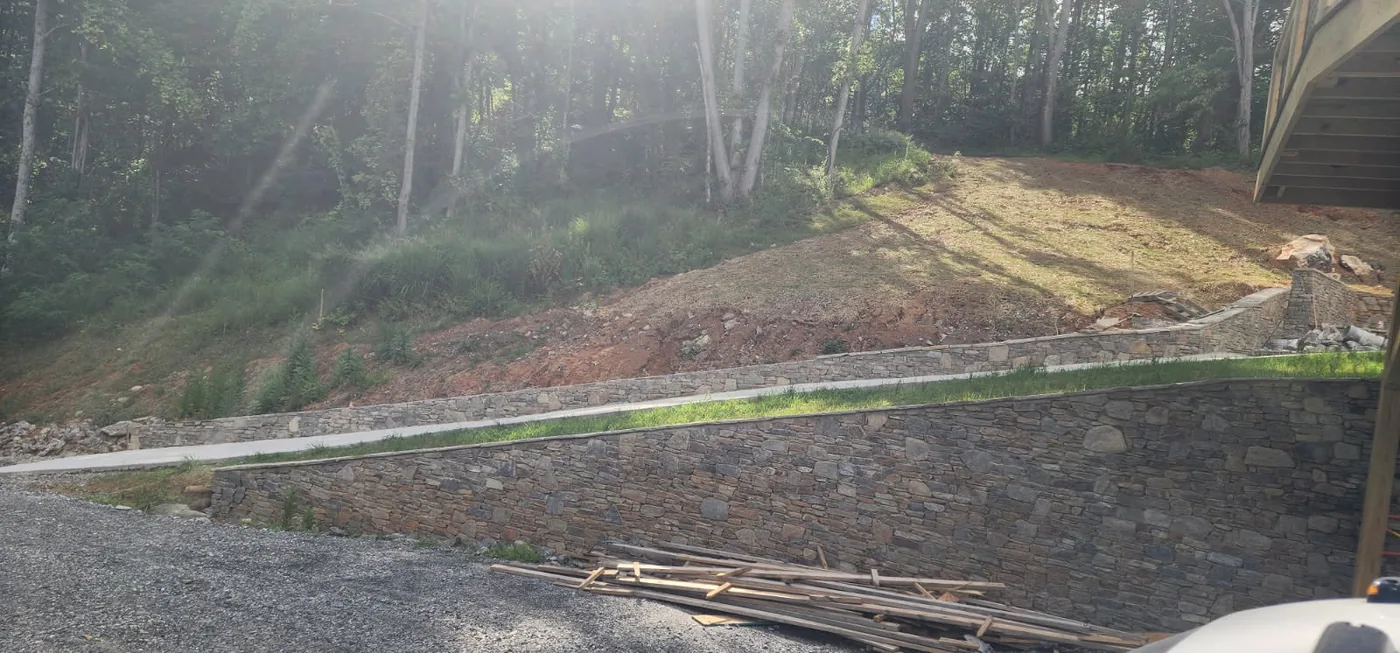
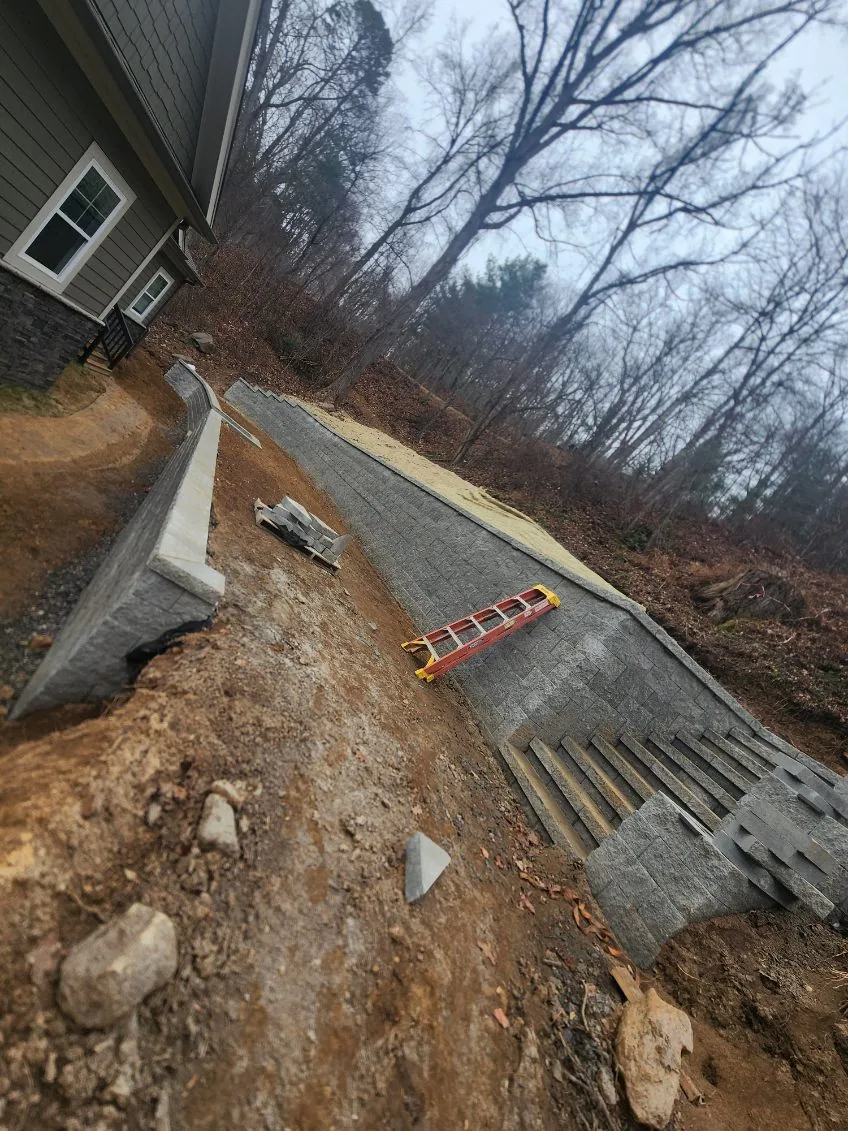
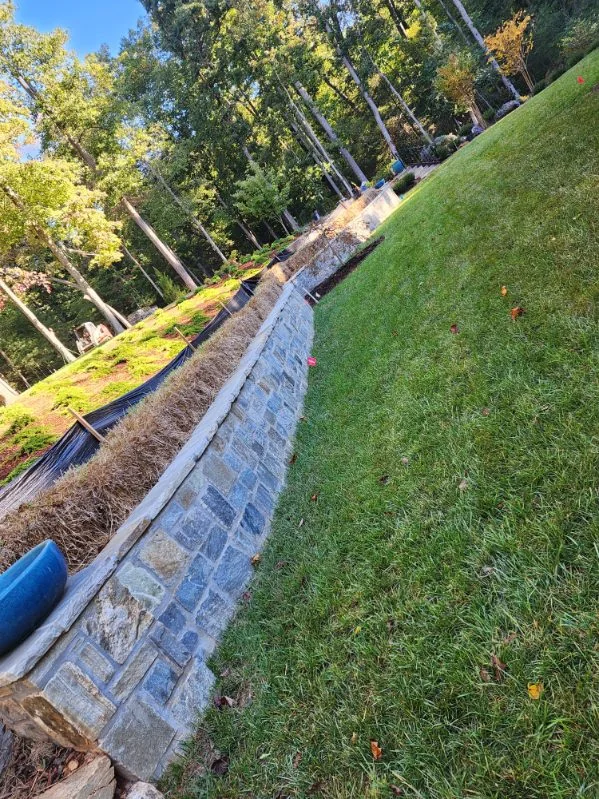
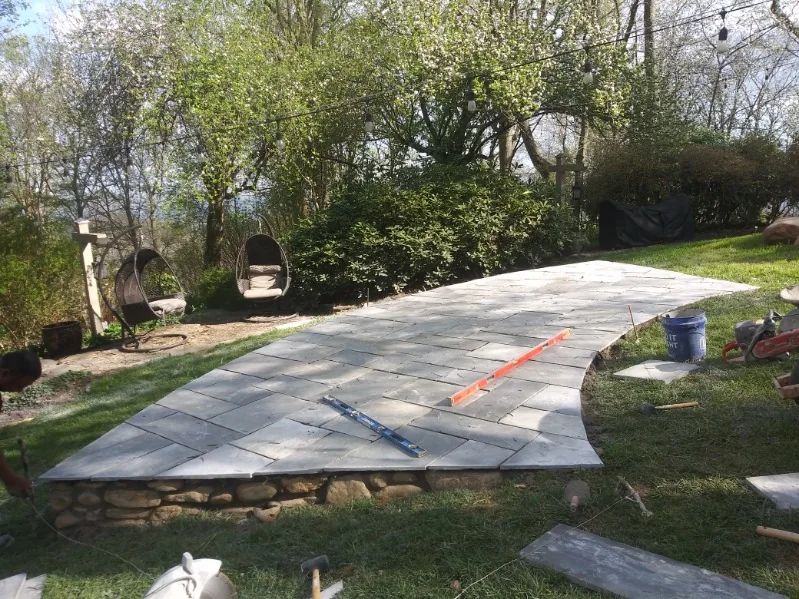
The soils mapped around Mill Spring.
What the USDA soil survey maps inside a circle of 1.5 miles around Mill Spring: 18 soil map units over about 4,500 acres. These are the largest, with the slope and water figures behind the work on lots around Mill Spring.
| Soil map unit | Share of ground | Slope | Drainage class | On the map | What it means |
|---|---|---|---|---|---|
| Pacolet sandy clay loam, 15 to 25 percent slopes, moderately eroded | 26% | 20.1% | Well drained | no flooding, shallow rock or shallow water on the map | Wall / slope work |
| Rion sandy loam, 25 to 45 percent slopes | 21% | 35% | Well drained | no flooding, shallow rock or shallow water on the map | Wall / slope work |
| Rion-Ashlar-Rock outcrop complex, 45 to 70 percent slopes | 16% | 58% | Well drained | rock at the surface | Wall / slope work |
| Pacolet sandy clay loam, 8 to 15 percent slopes, moderately eroded | 12% | 12% | Well drained | no flooding, shallow rock or shallow water on the map | Surface grade |
| Madison sandy clay loam, 8 to 15 percent slopes, moderately eroded | 10% | 12% | Well drained | no flooding, shallow rock or shallow water on the map | Surface grade |
| Madison sandy clay loam, 15 to 25 percent slopes, moderately eroded | 5% | 20% | Well drained | no flooding, shallow rock or shallow water on the map | Wall / slope work |
Across the whole circle: 71% of the ground is mapped at a 15% slope or steeper, 3% as moderately well to very poorly drained soil, and 17% with bedrock within about 40 inches. The town point sits in the USGS watershed unit "Wheat Creek-Green River". Nearest NOAA rainfall normal: 60 inches a year (Columbus 6.6 NNW, 5.7 miles off). Pulled 2026-11-09 from USDA-NRCS Soil Data Access, the USGS hydrography datasets and NOAA 1991–2020 normals. A soil map is not a site test: we confirm your Mill Spring lot on the free site walk.
What a retaining wall costs in Mill Spring, NC
These are typical Western North Carolina market ranges, not a Maidenhair Landscaping quote. North Carolina construction runs about 12% below the national average, but our mountain terrain — 15–40%+ slopes, weathered bedrock and saprolite, clay, and tight access — pushes most jobs toward the high end of every range. A flat infill lot sits low; a steep escarpment lot sits at or above the top. Your exact price comes from a free on-site estimate.
| Item | Typical WNC range | Notes |
|---|---|---|
| Segmental block wall (SRW), installed | $30–$60/sq ft face | interlocking concrete block; geogrid + drainage on taller walls |
| Natural stone / boulder wall, installed | $35–$90/sq ft face | labor- and stone-heavy; mountain access pushes the high end |
| Timber / treated-tie wall | $16–$35/sq ft face | lowest up-front, shortest life on a WNC slope |
| Typical residential wall project | $4,000–$25,000 | small garden wall to a tall engineered slope wall |
What drives it: wall height (over ~4 ft usually needs engineering), wall type (boulder/stone vs block vs timber), drainage and geogrid behind the wall, slope and equipment access, stone haul distance, and whether a failing wall has to be torn out first.
Source: published WNC/NC market ranges via homeguide.com and angi.com . Exact pricing on your lot comes from a free on-site estimate — call (828) 702-7125.
How we do it in Mill Spring.
Read the slope & soil
We check the grade and the drainage class on your Mill Spring lot, and find where rock or saprolite starts.
Set drainage & base
We build the drainage and the base first — the part that decides whether the work lasts on a slope.
Build it
Wall, driveway, or grade built to the slope, with the right batter, footing, and outlet.
Prove & clean
We confirm it sheds water and holds, then restore the surface clean.
Retaining Walls in Mill Spring: common questions
Can you build a wall for a barn or arena pad in Mill Spring?
Will I hit rock on my Mill Spring land?
Do you need an engineer for a retaining wall in Mill Spring?
Are you local to Mill Spring, and are you insured?
Retaining Walls near Mill Spring.
We work Mill Spring and the towns around it. Same service, local detail for each:
Other services we do in Mill Spring.
Need retaining walls in Mill Spring?
Tell us what you're dealing with — we'll walk the lot, read the soil and grade, and put a real number in writing, free.
We'll reach out within 24 hours to schedule your free on-site estimate. Prefer to talk now? Call (828) 702-7125.
- We confirm the details and book a time
- We walk the site and talk through the slope, soil, and access
- You get a clear, written, line-item scope